Know When Every Store Opens, Closes, or Moves After Hours — From One Dashboard
Tech4LYF helped transform store shutter monitoring from manual confirmation into a real-time, alert-driven visibility system for multi-location retail…
View case studyManufacturing energy is one of the largest controllable costs on any shop floor — and one of the least visible. Tech4LYF built a real-time shop floor energy monitoring…
Manufacturing energy is one of the largest controllable costs on any shop
floor — and one of the least visible. Tech4LYF built a real-time shop floor
energy monitoring platform for a global automotive manufacturing group,
giving plant managers and energy teams live machine-level consumption data,
idle versus active status intelligence, floor-by-floor comparison, and
automated deviation alerts — transforming energy from an unmanaged overhead
into a live operational metric.
Manufacturing energy costs are not a fixed overhead — they are a moving target
that shifts every hour based on which machines are running, which lines are
active, which shifts are operating, and how much idle consumption is draining
power without producing anything.
For a global automotive manufacturing group operating large-scale shop floors
in India, energy was one of the highest controllable operational costs on the
plant. But controlling it requires something the organisation did not have —
visibility. Not monthly energy bills from the utility provider. Not floor-level
estimates from manual readings. Real, machine-level, live energy consumption
data, organised in a way that plant managers and energy teams could actually
use to make decisions.
The challenges the organisation faced were significant and interconnected:
– Energy consumption data existed only at the facility level — from utility
meters — giving no indication of which shop floor, which production line,
or which specific machine was responsible for consumption at any given time
– There was no way to differentiate between productive consumption (machines
actively running production cycles) and idle consumption (machines powered
on but not working) — both appeared identically in the energy bill
– Idle machine consumption — motors left running during breaks, shift changes,
and unplanned stoppages — was a known cost problem with no measurement system
to quantify or act on it
– Plant managers could not compare energy efficiency between shop floors,
between production lines, or between shifts — making it impossible to
identify where waste was occurring or where performance was strong
– Energy reporting was a manual, retrospective exercise — by the time reports
were compiled, the consumption had already happened with no opportunity
to intervene
– Maintenance and operations teams had no alert system when a machine’s energy
profile deviated from its expected consumption baseline — a signal that often
indicates mechanical inefficiency, motor degradation, or operational error
long before it becomes a breakdown
– Sustainability and ESG reporting requirements demanded granular energy data
that the existing infrastructure simply could not produce
The organisation needed a software platform that could transform raw energy
data from across the shop floor into clear, actionable, real-time intelligence
— machine by machine, floor by floor, shift by shift.
Tech4LYF designed and built a purpose-built shop floor energy monitoring
platform that gives the automotive group complete, live visibility into
energy consumption at every level of their manufacturing operation — from
the entire plant down to an individual machine on a specific production line.
The platform connects to energy metering infrastructure installed at machine
and distribution-board level across each shop floor. Consumption data is
captured in real time and streamed to the central software platform, where
it is processed, structured, and displayed through an intuitive web-based
dashboard accessible to plant managers, energy engineers, and operations
leadership.
The dashboard presents energy consumption across three navigable levels.
At the plant level, management sees total consumption, cost trends, and
performance against energy targets across the entire facility. At the shop
floor level, each production floor is shown individually — with its own
consumption breakdown, efficiency metrics, and comparison data against
other floors and against historical baselines. At the machine level, every
individual piece of equipment on the floor has its own consumption profile
— showing live power draw, accumulated daily and shift consumption, and
current operational status.
The operational status layer is one of the most valuable elements of the
platform. Every machine is continuously classified as either active
(consuming energy as part of a production cycle), idle (powered on but not
performing productive work), or off. Idle consumption — which is invisible
in conventional energy reporting — becomes visible, measurable, and
actionable. Plant teams can see exactly which machines are running idle,
for how long, and how much that idle state is costing per shift, per day,
and per month.
The platform also generates automated alerts when a machine’s real-time
energy consumption deviates beyond configured thresholds from its expected
baseline — flagging potential mechanical inefficiency, abnormal load
conditions, or operational errors before they escalate into failures or
quality issues.
All data is retained historically, enabling the organisation to generate
granular energy reports for internal performance management, operational
improvement initiatives, and ESG and sustainability compliance reporting —
with the machine-level detail that regulatory and audit requirements
increasingly demand.
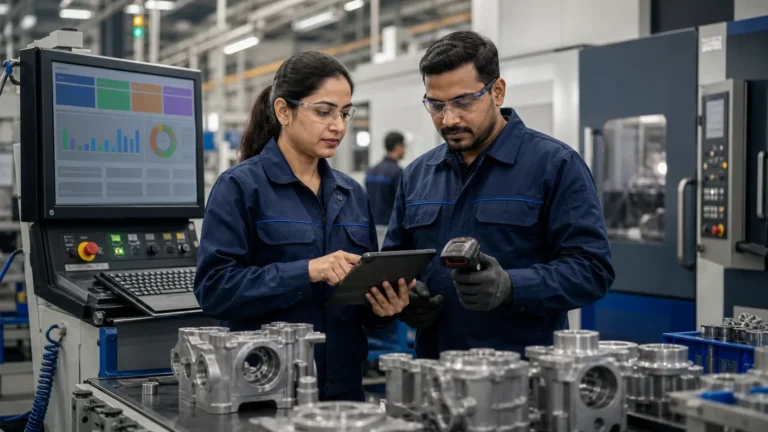
Every machine on every shop floor is connected to the platform through energy metering infrastructure. Live power draw, accumulated shift consumption, daily totals, and cost equivalents are displayed per machine — giving plant teams the granular visibility that facility-level or floor-level metering cannot provide. No averaging. No estimation. Actual consumption per asset, live.
The platform continuously classifies each machine as active (running a productive cycle), idle (powered on with no productive output), or off. Idle consumption — the single largest source of controllable energy waste in most manufacturing environments — is separated from productive consumption, made visible in real time, and accumulated into shift, daily, and monthly idle cost reports that operations teams can act on immediately.
Energy consumption is structured across three navigable levels — plant, shop floor, and machine. Managers can compare energy performance between shop floors, between production lines on the same floor, and between shifts operating the same equipment. Performance against energy targets and against historical baselines is displayed continuously, making benchmarking a live activity rather than a retrospective exercise.
Every machine has a configurable expected consumption baseline. When a machine's real-time energy draw deviates beyond the defined threshold — drawing more than expected, less than expected, or shifting its idle-to-active ratio — the platform generates an automatic alert to the relevant maintenance or operations team. Abnormal energy profiles often indicate motor degradation, mechanical inefficiency, or operational error — catching them early prevents escalation.
Energy consumption is tracked and reported at shift level — making it possible to compare energy performance between morning, afternoon, and night shifts operating the same machines and floors. Shift-level data reveals operational behaviour differences that aggregate daily reports mask entirely, giving plant leadership the context to address efficiency gaps at the right level of the organisation.
All historical energy data is retained in the platform with machine-level granularity. The reporting engine generates structured consumption reports for any time period, any floor, any machine, or any shift — formatted to support internal energy governance, sustainability performance reporting, and the ESG disclosure requirements that global automotive manufacturers are increasingly required to meet for regulatory compliance and investor reporting.
The shop floor energy monitoring platform transformed how the automotive
group understood, managed, and reported their manufacturing energy consumption.
For the first time, plant managers had a live view of energy consumption at
machine level — not as a monthly bill summary, but as a continuous, real-time
operational signal. Every machine on every shop floor was visible. Every idle
event was captured, timestamped, and costed. Every shop floor could be
compared against every other — by consumption, by efficiency ratio, and by
shift performance.
The idle consumption visibility alone revealed a significant and previously
invisible source of energy waste. Machines running idle during breaks,
between shifts, and during unplanned stoppages — consumption that had always
existed but never been measured — were now quantified in real time. Operations
teams had both the data and the alert system to act on it immediately.
Plant managers and energy engineers moved from monthly retrospective reports
to live daily dashboards. Energy targets could be set, monitored in real time,
and reported against with the granularity that internal governance and external
ESG requirements demanded.
The deviation alert system added a predictive layer to the platform —
flagging machines with abnormal consumption profiles before operational
failures occurred, connecting energy monitoring directly to maintenance
intelligence.
What Tech4LYF delivered was not simply an energy reporting tool. It was
a complete operational intelligence platform for shop floor energy — built
for the scale, complexity, and reporting requirements of one of the world’s
largest automotive manufacturing organisations, and deployed on time
within a three-month engagement.
Plant Operations Leadership
Global Automotive Manufacturing Group
Manufacturing energy has always been one of our highest controllable costs — but we had no way to see it below the facility level. Tech4LYF built a platform that shows us exactly which machine, which floor, and which shift is consuming what — and flags idle consumption the moment it starts. For the first time, energy is something we can manage in real time, not just report on after the fact.
Tech4LYF builds shop floor energy monitoring platforms, industrial IoT dashboards, machine-level consumption intelligence systems, and ESG energy reporting tools for manufacturing plants, automotive facilities, and industrial operations across India and globally. If energy is a cost you can see but cannot yet control — we will build you the platform that changes that. Share your facility details and let's start the conversation.