Capacity and Bottleneck Simulation | Tech4LYF India
Model demand, machines, labour, shifts and buffers to identify capacity limits and compare improvement scenarios before changing the factory.

Find the Constraint Before It Limits Production

Introduction

Measure Capacity, Expose Constraints and Compare Improvement Options

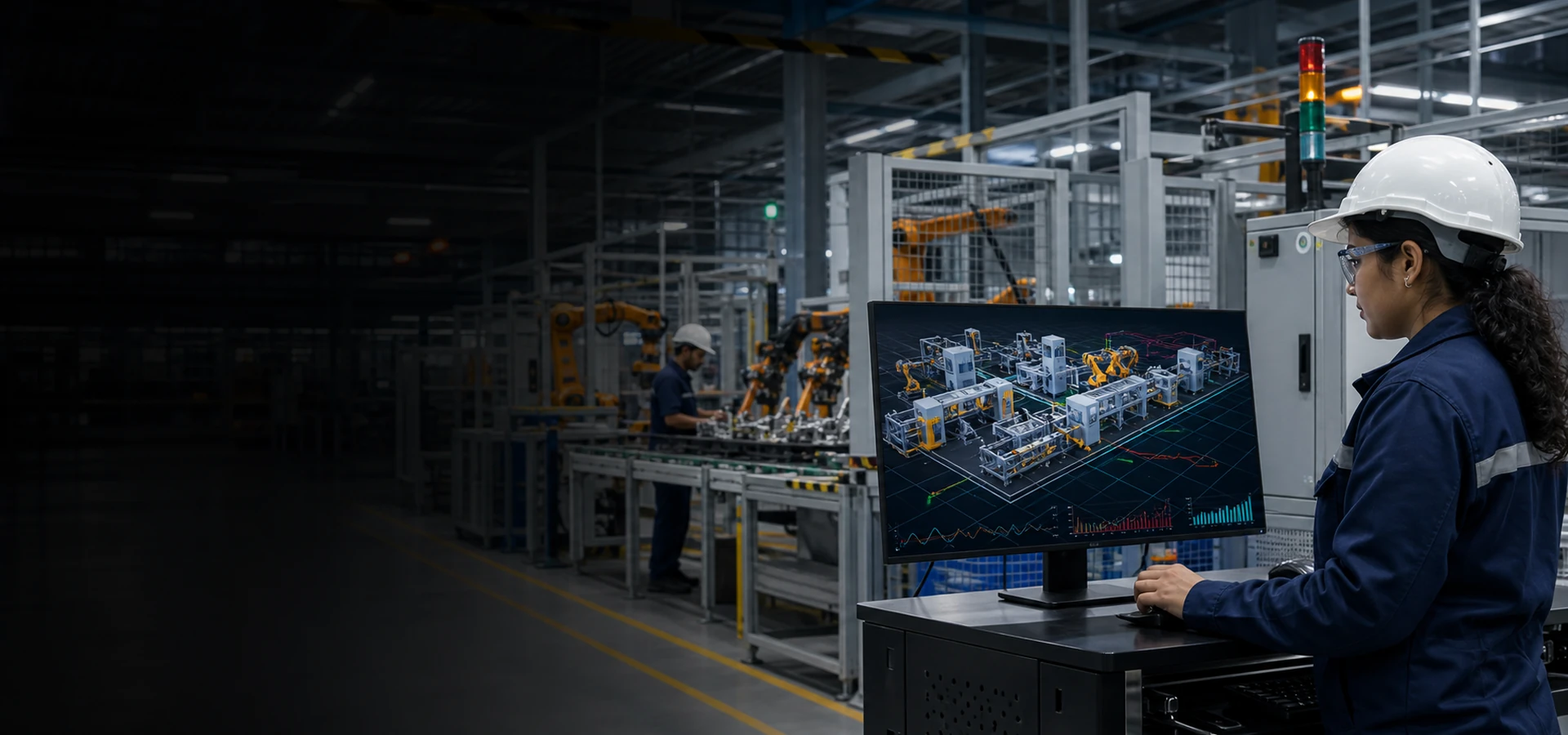
Capacity and bottleneck simulation creates a virtual representation of production demand, machines, workstations, labour, shifts, buffers and operating rules. Manufacturers can use the model to understand achievable capacity, identify limiting resources and evaluate improvement options before changing the physical operation.

Installed or theoretical capacity does not always represent the output a factory can achieve. Actual production can be affected by cycle-time variation, changeovers, equipment failures, operator availability, material shortages, inspection delays, rework, blocked stations and insufficient buffer space.

A bottleneck is also not necessarily the machine with the longest average cycle time. A resource may constrain production because it has high utilisation, variable processing time, frequent downtime, limited labour availability or dependencies on upstream and downstream operations.

Tech4LYF represents these relationships in a measurable simulation model. Products or batches move through defined routes while competing for machines, operators, tools, fixtures, inspection resources and material-handling capacity. The model measures how these interactions affect throughput, utilisation, queues, work-in-progress, waiting time and production lead time.

Production teams can compare demand volumes, product mix, batch sizes, shift patterns, staffing levels, machine quantities, buffer capacities, maintenance assumptions and routing alternatives. Each scenario is evaluated against the same approved baseline, allowing decision-makers to compare the effects of proposed changes consistently.

Bottlenecks can move when production conditions change. Relieving one constraint may expose another machine, operator, buffer, inspection stage or material-handling resource as the next limitation. Tech4LYF therefore evaluates both persistent and shifting constraints across multiple operating scenarios.

The baseline model is reviewed with production, maintenance and engineering teams. Where dependable operating records are available, simulated behaviour is compared with observed throughput, utilisation, downtime and queue conditions before alternative scenarios are tested.

Assumptions and data limitations remain documented. Simulation results support engineering and operational decisions, but they do not guarantee a specific production outcome when actual conditions differ from the approved model inputs.

Capacity and bottleneck simulation can support existing factories, proposed production lines and expansion programmes. An engagement can begin with one constrained line, high-demand product family or equipment-investment decision before expanding across connected processes.

Tech4LYF provides capacity and bottleneck simulation services for manufacturers in Chennai, across India and for multi-location industrial operations. Each model is developed around a defined capacity question, measurable operating evidence and agreed decision criteria.
Turn Production Constraints into Measurable Decisions

Model complete production workflows through our Production Line Simulation Services.
Build Capacity Plans on Operational Evidence

Compare demand, resources and production rules in a validated model before committing equipment, labour, floor space or operating time.

Achievable Capacity

Estimate practical output using validated cycle times, changeovers, downtime, shifts and operating constraints.

Constraint Visibility

Identify machines, labour, buffers and supporting resources that restrict overall production flow.

Demand Scenario Testing

Test changing volumes, product mix and delivery requirements against available production capacity.

Balanced Resources

Compare machine quantities, staffing levels, shifts and resource assignments across production scenarios.

Controlled WIP

Analyse queues, waiting time and buffer capacity between operations to reduce unnecessary accumulation.

Evidence-Led Investment

Compare equipment and capacity alternatives before approving physical expansion or capital expenditure.

5

Service Rating

Proven

Validated

Scalable

Plant-ready
Capacity & Bottleneck Simulation Capabilities

Test Capacity, Constraints and Resource Alternatives

Configure the model around your demand, products, routes, machines, labour, shifts, buffers, variability and production-control rules.

Capacity Model Development Model machines, workstations, production routes, resources and operating rules within the agreed system boundary.
Demand vs Capacity Analysis Compare required production volumes with achievable output under selected demand and operating scenarios.
Bottleneck Identification Identify resources, queues and dependencies that restrict overall throughput or increase production lead time.
Dynamic Constraint Analysis Evaluate how constraints move when demand, product mix, staffing, equipment or operating rules change.
Machine & Labour Capacity Model machine availability, operator skills, staffing levels and shared-resource requirements.
Shift & Calendar Modelling Represent shifts, breaks, holidays, overtime, planned maintenance and resource-availability calendars.
Buffer & Queue Analysis Measure buffer utilisation, queue length, waiting time, blocked stations and work-in-progress accumulation.
Product Mix & Routing Test multiple product families, batch sizes, priorities, alternative routes and rework flows.
Cycle & Changeover Variation Represent validated processing-time distributions, setup requirements and sequence-dependent changeovers.
Failure & Downtime Behaviour Evaluate supported equipment failures, repair times, maintenance conditions and availability assumptions.
Capacity Scenario Comparison Compare additional machines, labour changes, buffer sizes, shifts, routing rules and demand alternatives.
Decision Reports Present throughput, utilisation, queues, capacity margins, constraints, assumptions and scenario comparisons.

Our Development Process

01
Capacity Objective & Scope

Define the demand question, process boundary, required scenarios, outputs and measurable acceptance criteria.

02
Process & Data Mapping

Collect routes, cycle times, changeovers, downtime, shifts, resources, buffers and production rules.

03
Baseline Capacity Model

Build the current-state model using approved operating logic, variability and reporting measures.

04
Verification & Validation

Review model logic with plant teams and compare baseline results with approved operating evidence.

05
Constraint Experiments

Test demand, equipment, labour, buffer, shift and routing alternatives to identify capacity limitations.

06
Decision Handover & Scale

Present findings, assumptions and limitations, then support approved refinement or expansion.

Basic information

Frequently asked questions.

Capacity and bottleneck simulation models production demand, machines, labour, shifts, buffers and operating rules. It helps manufacturers estimate achievable output, identify limiting resources and compare improvement scenarios before implementing physical changes.

A production bottleneck is a machine, workstation, labour group, inspection stage, buffer or supporting resource that limits overall system throughput under defined operating conditions.

No. A bottleneck may result from downtime, changeovers, variability, labour shortages, material availability, inspection delays or dependencies between operations. It can also move when demand or product mix changes.

Typical inputs include demand, product routes, cycle times, changeovers, machine availability, repair behaviour, shift calendars, labour, buffers, batch sizes, product mix and operating rules. Requirements depend on the decision being tested.

Yes. Existing production systems can be modelled using observed operating data and approved process rules. The baseline model should be validated before improvement scenarios are compared.

Yes. Equipment specifications, proposed layouts, expected cycle times, staffing and demand assumptions can be modelled to compare design alternatives before physical installation.

OEE measures equipment availability, performance and quality for a defined asset or process. Capacity simulation models interactions across multiple resources and tests how proposed changes may affect future system performance.

No. A logical discrete-event model may be sufficient for capacity and bottleneck analysis. A 3D view is useful when spatial movement, layout communication or stakeholder visualisation is important.

Yes. Approved demand, production orders, routes, schedules, machine events, downtime and output records can support model inputs and validation when system access and data quality are suitable.

The timeline depends on the process boundary, number of products and resources, data readiness, model complexity, validation requirements and scenarios. Tech4LYF provides an itemised plan after reviewing the capacity question and available evidence.

Connect Data Updated Successfully!
Say
Hello!

I understand that my data will be hold securely in accordance with the privacy policy.

<

Other business services

Digital Twin Solutions for Manufacturing

Create live virtual replicas for monitoring, prediction and what-if analysis.

Production Line Simulation Services

Test throughput, bottlenecks and production scenarios before changing the shop floor.

Trusted By Industry Leaders

Zealeye Logo
Zealeye Logo
Zealeye Logo
Zealeye Logo
Zealeye Logo
Zealeye Logo
Zealeye Logo
Zealeye Logo
Annai Printers Logo
Deejos Logo
DICS Logo
ICICI Bank Logo
IORTA Logo
Panuval Logo
Paradigm Logo
Quicup Logo
SPCET Logo
SRM Logo
Thejo Logo
Trilok Logo
Wingo Logo
Zealeye Logo
Scroll