Finite Capacity Production Scheduling Case Study | Tech4LYF
Connected Production Planning

Finite-Capacity Scheduling for Precision Manufacturing

What is finite-capacity production scheduling? Finite-capacity production scheduling assigns manufacturing operations only when the required machine, work centre, labour, material and production time are available. For this precision…

Client A Leading Precision Components Manufacturer
Category Industries
Location India
Duration Phased Implementation
Overview

How the project moved from business problem to working system

What is finite-capacity production scheduling? Finite-capacity production scheduling assigns manufacturing operations only when the required machine, work centre, labour, material and production time are available.

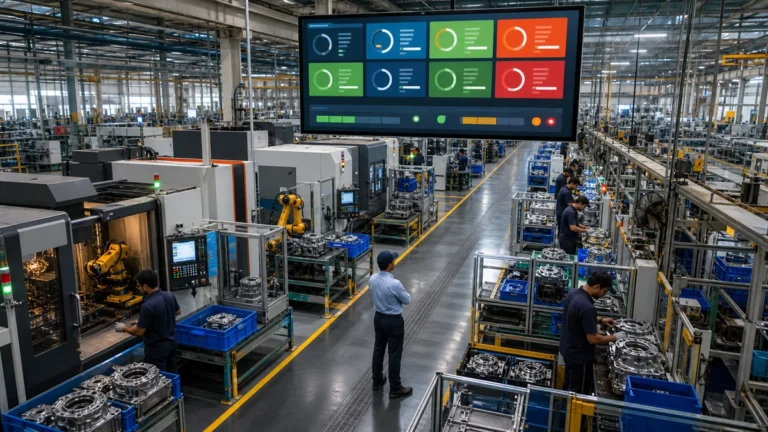
For this precision components manufacturer, Tech4LYF developed a connected scheduling platform that converted ERP production demand into an achievable, time-sequenced shop-floor plan.

The system brought production orders, routings, cycle times, machine calendars, setup requirements, materials and delivery priorities into one planning workflow. Planners could identify capacity conflicts before releasing work and respond systematically when production conditions changed.

The solution retained planner control while replacing fragmented spreadsheets with a shared scheduling model connected to real operational information.

Impact

Results that made the work visible

Finite Capacity Machine and work-centre availability considered
Live Priorities Due dates and urgent orders visible to planners
Controlled Schedule changes reviewed before production release
Connected Flow ERP demand linked with shop-floor feedback

The business problem

A leading precision components manufacturer was managing a complex production environment involving customer orders, recurring jobs, multiple routings, shared machines, changing delivery priorities and material-dependent operations.

The company’s ERP system contained production orders and material information, but detailed machine scheduling was still managed through spreadsheets, planning boards and frequent coordination between planners and shop-floor supervisors.

This created several connected production-planning challenges:

  • Schedules were prepared without a reliable view of finite machine and work-centre capacity.
  • Several orders could be assigned to the same resource during the same production window.
  • Machine breakdowns, urgent orders and material delays required planners to rebuild schedules manually.
  • Cycle times, setup requirements and alternate machines were not consistently considered.
  • Frequent changeovers reduced available production time and disrupted planned sequences.
  • Planners had limited visibility into overloaded work centres and orders at risk of delay.
  • ERP order priorities were not directly connected to the latest shop-floor execution status.
  • Planning decisions depended heavily on individual knowledge and repeated phone or spreadsheet updates.

The manufacturer needed a controlled production scheduling system that could convert ERP demand into an achievable plan using actual capacity, routings, calendars, materials and shop-floor conditions.

What Tech4LYF built

Tech4LYF designed a finite-capacity production planning and scheduling system around the manufacturer’s actual production rules, resources and approval workflows.

The solution imported open production orders, required quantities, due dates, routings and material information from the existing ERP. It then evaluated machine availability, work-centre calendars, cycle times, setup times, changeover requirements and order priorities before assigning each operation to an available production window.

A central planning dashboard allowed authorised planners to review scheduled operations by machine, work centre, order, customer priority and delivery date. Capacity conflicts, overloaded resources, material constraints and potentially delayed orders were made visible before work was released to production.

Tech4LYF also introduced controlled dynamic replanning. When a machine became unavailable, material was delayed or a priority order was introduced, the system identified the affected operations and generated an updated schedule for planner review. Unaffected work remained stable, avoiding unnecessary disruption across the complete production plan.

The scheduling platform was connected with ERP demand and shop-floor execution feedback. Approved schedules could be released to production, while completed quantities, operation status and downtime information could return from MES or authorised production users.

The system was implemented in phases, beginning with verified orders, routings and critical work centres. Additional production rules and resources could then be introduced after planners validated the initial scheduling model.

Capabilities

Core features delivered

1

Finite-Capacity Scheduling

Operations were assigned only when the required machine, work centre and production window were available, preventing unrealistic capacity overlaps.

2

Routing and Cycle-Time Model

Production routings, operation sequences, cycle times, setup times and alternate resources were incorporated into the scheduling model.

3

Priority-Based Sequencing

Orders could be scheduled using due dates, customer priorities, material readiness and planner-defined production policies.

4

Changeover-Aware Planning

Compatible jobs could be grouped to limit avoidable setups while protecting delivery and production priorities.

5

Dynamic Replanning

Machine breakdowns, urgent orders and material delays could trigger controlled rescheduling of the affected operations.

6

ERP and MES Integration

ERP production demand was connected with approved schedules, MES execution status, completed quantities and downtime feedback.

The outcome

The manufacturer gained a shared and capacity-aware production schedule for planners, supervisors and operations teams.

Orders could be sequenced using actual machine availability, routing requirements, delivery priorities and production calendars instead of being assigned against assumed capacity. Planners could identify overloaded work centres, material-dependent operations and delivery risks before releasing work.

When a breakdown, material delay or urgent order affected the plan, the scheduling team could review the operational impact and release a controlled revised schedule without manually rebuilding every unaffected operation.

The connection between ERP demand, production scheduling and shop-floor feedback created a scalable planning foundation that could be expanded across additional resources, lines and plants.

Customer voice

Project Outcome
Production Planning Transformation

The scheduling system created one controlled view of orders, capacity, constraints and production priorities.
More stories

Related case studies

Need an Achievable Production Schedule Built Around Real Capacity?

Tech4LYF develops production planning and scheduling software that connects ERP orders with machines, work centres, materials, routings and shop-floor feedback. Start with one planning bottleneck or critical production area and expand after the scheduling model is validated.

Start a project

Trusted By Industry Leaders

Zealeye Logo
Zealeye Logo
Zealeye Logo
Zealeye Logo
Zealeye Logo
Zealeye Logo
Zealeye Logo
Zealeye Logo
Annai Printers Logo
Deejos Logo
DICS Logo
ICICI Bank Logo
IORTA Logo
Panuval Logo
Paradigm Logo
Quicup Logo
SPCET Logo
SRM Logo
Thejo Logo
Trilok Logo
Wingo Logo
Zealeye Logo
Scroll