How Tech4LYF Built a Connected CMMS for a Leading Multi-Line Manufacturer
Tech4LYF built a connected CMMS for preventive maintenance, technician work orders, asset history, spare-parts control and reliability reporting.
View case studyA leading automotive components manufacturer needed to close the information gap between ERP production planning and actual shop-floor execution. Tech4LYF developed a modular Manufacturing Execution System that connected…
A leading automotive components manufacturer needed to close the information gap between ERP production planning and actual shop-floor execution.
Tech4LYF developed a modular Manufacturing Execution System that connected production orders with work centres, operators, machines and shop-floor events. The platform created live visibility into order progress, work-in-progress, good output, downtime, scrap and production exceptions.
Instead of waiting for paper reports to be consolidated after each shift, supervisors could monitor active production and respond to delays while corrective action was still possible. Reviewed execution data could also be returned to ERP through a structured feedback workflow.
The manufacturer used ERP to create production orders, plan materials and record finished output. However, once an order reached the shop floor, its execution was managed through paper job cards, spreadsheets and delayed shift reports.
Production supervisors could not obtain a reliable live view of what was running, waiting, stopped or completed. Information about output, work-in-progress, downtime, scrap and rework was consolidated only after the shift, limiting the team’s ability to respond while production was active.
The principal operational challenges included:
The organisation needed an operational layer between ERP and the shop floor that could control production execution and return dependable actual-production data.
Tech4LYF designed a modular Manufacturing Execution System around the plant’s production routing, work-centre structure, operator responsibilities and existing ERP workflows.
The MES received approved production orders from ERP, including the product, required quantity, routing, operation sequence, priority and due date. Supervisors could review, prioritise and release these orders to the correct work centres through a controlled dispatch screen.
Shop-floor terminals presented operators with their assigned work and the current production requirements. Production information was captured through operator input, barcode scanning and available machine or PLC signals.
Every production event was recorded against its operational context:
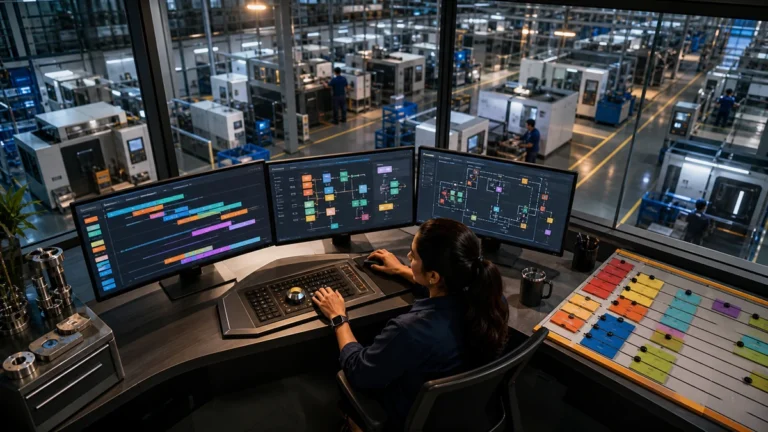
A role-based dashboard gave supervisors a live view of order progress, work-in-progress, output, downtime and delayed operations. Confirmed production quantities, scrap and completion status were structured for feedback to ERP, reducing repeated manual reporting.
The solution was designed for modular deployment, allowing the manufacturer to validate production tracking on a representative line before extending it to additional work centres, machines and MES modules.

Receive approved production orders, products, quantities, routing, priorities and due dates from ERP without recreating the same information manually.
Release and prioritise production orders for the correct lines, machines and work centres through a controlled supervisor workflow.
Track planned quantity, actual output, work-in-progress and operation status using operator entries, barcode scans and available machine data.
Record production stoppages with reason codes and associate good output, scrap and rework with the correct order, operation and shift.
Maintain a digital production history connecting orders, operations, work centres, machines, operators, quantities and timestamps.
Give supervisors live production visibility and return authorised quantities, scrap and completion status to ERP through a structured workflow.
The MES established a shared operational view for production planners, supervisors, operators and management. Production orders remained visible after ERP release and could be followed throughout shop-floor execution.
Supervisors could identify running, waiting, stopped, held and delayed orders without consolidating information from multiple paper records. Downtime, scrap, rework and good output were recorded against the relevant production order, operation, work centre and shift.
The connection between ERP planning and MES execution also improved production feedback. Approved orders moved to the shop floor for execution, while reviewed quantities and completion information were returned through a controlled digital workflow.
The manufacturer gained a scalable MES foundation that could be expanded with machine connectivity, in-process quality, material traceability, digital work instructions and advanced production analytics.
Plant Operations Leadership
A Leading Automotive Components Manufacturer
Insert a real quotation approved by the client.
Tech4LYF builds modular Manufacturing Execution Systems that connect production orders with work centres, operators, machines, materials, quality workflows and live shop-floor reporting. Start with one priority workflow and expand across lines and plants as adoption grows.