Vibration and temperature nodes
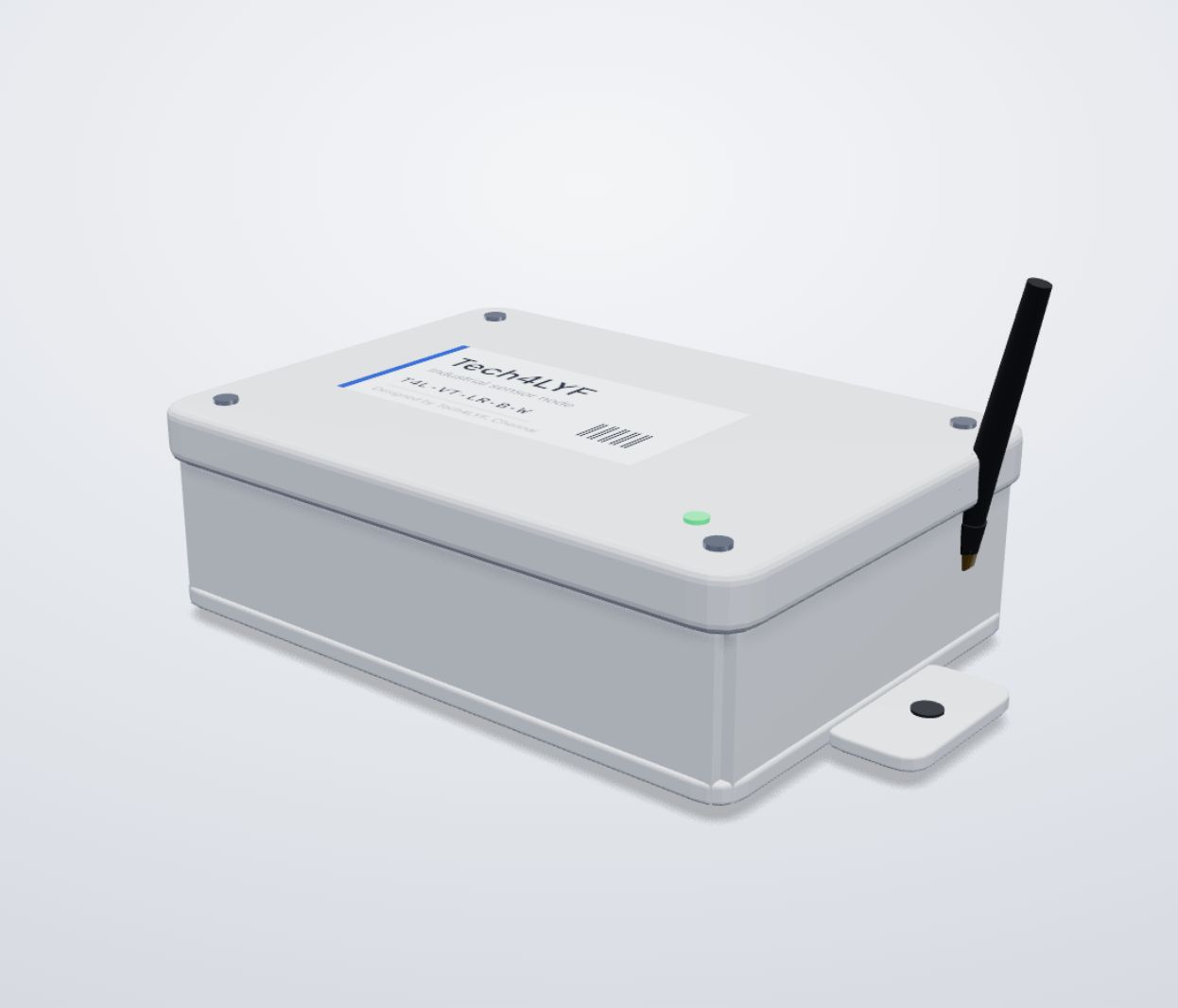
Magnet-mounted on motors, pumps, fans and gearboxes. Trends in vibration show bearing wear and misalignment weeks before a breakdown.
Industrial IoT devices · Made in Chennai
We design the sensor nodes, trackers and gateways that put machines, tanks, doors and people on a dashboard. Electronics, firmware, enclosure and cloud come from one team in Chennai.
An industrial IoT device is a small, rugged computer with a sensor and a radio. It sits on a machine, a tank, a door or a person's lanyard, takes a reading, and sends it to software where a supervisor can act on it. Good ones run for years without attention, survive heat, dust and vibration, and work with the network the site already has.
Most of the devices we are asked for fall into six families.
Device types
Magnet-mounted on motors, pumps, fans and gearboxes. Trends in vibration show bearing wear and misalignment weeks before a breakdown.
Clip-on CT clamps read run, idle and stop states and power use without touching the PLC. A quick way to start measuring utilisation.
Ultrasonic or pressure sensing for water, diesel, chemicals and grain. Refill alerts and daily consumption per tank.
Tags and fixed beacons that show where trolleys, tools or people are inside a building, zone by zone.
Reed switches and controllers that log every open and close, with alerts outside business hours.
LoRaWAN, BLE and Modbus gateways that collect readings on site and forward them over Ethernet, Wi-Fi or 4G.
From our project work
A custom PCB that tracks blade wear on conveyor belts, with LoRa, BLE, Wi-Fi and SIM connectivity options.
Read the case study Indoor trackingZone-level tracking of people inside a facility, built on BLE beacons and LoRa gateways.
Read the case study EnergyEnergy readings from automotive production lines, turned into per-machine and per-shift views.
Read the case study RetailShutter open and close events from stores across a retail chain, on one dashboard.
Read the case studyConnectivity
The radio decides battery life, what you need on site and how far the device can be from a receiver. This is how the four common options compare in a typical plant.
| Radio | Range in a plant | Battery life | Needs on site | Good for |
|---|---|---|---|---|
| LoRaWAN (IN865) | Whole plant from one or two gateways | Years | A LoRaWAN gateway | Many slow-changing sensors spread out |
| BLE | Tens of metres | Months to years | BLE gateways or a phone | Indoor tracking, short-range sensors |
| Wi-Fi | Wherever your Wi-Fi reaches | Best on mains | Your access points | A few devices with frequent data |
| 4G LTE | Anywhere with signal | Best on mains or solar | A data SIM per device | Remote and outdoor sites, vehicles |
Want a recommendation for your site? The IIoT connectivity advisor asks a few questions and suggests a setup.
Process
Cost factors
Every project is quoted on its own numbers. These are the things that move it most.
Tooling and setup are shared across the batch, so per-unit cost falls as volume grows.
An off-the-shelf box with a custom label is quickest. A moulded or machined housing takes longer and suits larger runs.
4G modules and solar packs cost more than LoRa or BLE on a primary cell. Reporting rate decides which power option works.
Any certification your market needs, plus the dashboard, mobile app or ERP integration that goes with the device.
Pick sensors, radio, power and housing in the IoT Device Studio. You get a 3D model and a spec sheet our hardware team can quote from.
FAQ
Yes. Tech4LYF designs industrial IoT devices in Chennai, covering the electronics, firmware, enclosure and the cloud dashboard, and takes them from prototype to production batches.
Yes. Clip-on current sensors, magnet-mounted vibration nodes and level sensors fit existing machines and tanks without changing the PLC or stopping production for long.
For many sensors across a plant, LoRaWAN with one or two gateways is usually simplest. Wi-Fi suits a few devices near an existing network, BLE suits indoor tracking, and 4G suits remote or outdoor sites.
It depends mostly on how often the device reports. A LoRa node that reports every 15 minutes can run for years on one primary cell, while a device reporting every few seconds is better on mains or solar.
Yes. The enclosure label, dashboard and mobile app can carry your brand through our OEM and white-label IoT service.
To a dashboard we set up for you, or straight into your ERP or SCADA over MQTT or an API. Tech4LYF HQ can show device data next to production and maintenance records.
Related
No spam. No pressure. Just a quick discovery call with our experts.